
We Did It, They Hid It
A digital archive of slave voyages details the largest forced migration in history
A digital archive of slave voyages details the largest forced migration in history

Philip Misevich, St. John's University; Daniel Domingues, University of Missouri-Columbia; David Eltis, Emory University; Nafees M. Khan, Clemson University , and Nicholas Radburn, University of Southern California – Dornsife College of Letters, Arts and Sciences
Between 1500 and 1866, slave traders forced 12.5 million Africans aboard transatlantic slave vessels. Before 1820, four enslaved Africans crossed the Atlantic for every European, making Africa the demographic wellspring for the repopulation of the Americas after Columbus’ voyages. The slave trade pulled virtually every port that faced the Atlantic Ocean – from Copenhagen to Cape Town and Boston to Buenos Aires – into its orbit.
To document this enormous trade – the largest forced oceanic migration in human history – our team launched Voyages: The Trans-Atlantic Slave Trade Database, a freely available online resource that lets visitors search through and analyze information on nearly 36,000 slave voyages that occurred between 1514 and 1866.
Inspired by the remarkable public response, we recently developed an animation feature that helps bring into clearer focus the horrifying scale and duration of the trade. The site also recently implemented a system for visitors to contribute new data. In the last year alone we have added more than a thousand new voyages and revised details on many others.
The data have revolutionized scholarship on the slave trade and provided the foundation for new insights into how enslaved people experienced and resisted their captivity. They have also further underscored the distinctive transatlantic connections that the trade fostered.
Records of unique slave voyages lie at the heart of the project. Clicking on individual voyages listed in the site opens their profiles, which comprise more than 70 distinct fields that collectively help tell that voyage’s story.
From which port did the voyage begin? To which places in Africa did it go? How many enslaved people perished during the Middle Passage? And where did those enslaved Africans end the oceanic portion of their enslavement and begin their lives as slaves in the Americas?
Working with complex data
Given the size and complexity of the slave trade, combining the sources that document slave ships’ activities into a single database has presented numerous challenges. Records are written in numerous languages and maintained in archives, libraries and private collections located in dozens of countries. Many of these are developing nations that lack the financial resources to invest in sustained systems of document preservation.
Even when they are relatively easy to access, documents on slave voyages provide uneven information. Ship logs comprehensively describe places of travel and list the numbers of enslaved people purchased and the captain and crew. By contrast, port-entry records in newspapers might merely produce the name of the vessel and the number of captives who survived the Middle Passage.
These varied sources can be hard to reconcile. The numbers of slaves loaded or removed from a particular vessel might vary widely. Or perhaps a vessel carried registration papers that aimed to mask its actual origins, especially after the legal abolition of the trade in 1808.
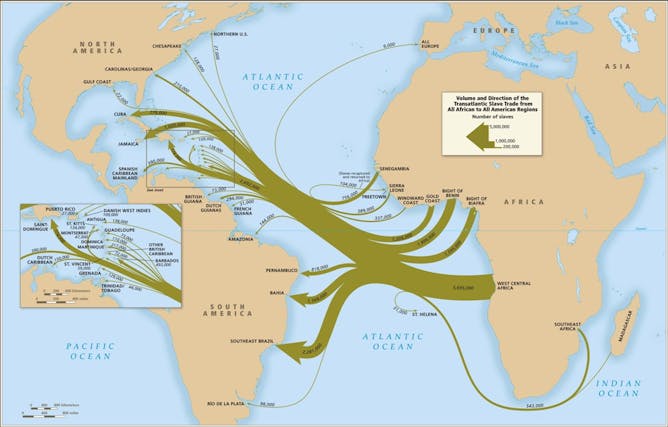
Of course, not all slave voyages left surviving records. Gaps will consequently remain in coverage, even if they continue to narrow. Perhaps three out of every four slaving voyages are now documented in the database. Aiming to account for missing data, a separate assessment tool enables users to gain a clear understanding of the volume and structure of the slave trade and consider how it changed over time and across space.
Engagement with Voyages site
While gathering data on the slave trade is not new, using these data to compile comprehensive databases for the public has become feasible only in the internet age. Digital projects make it possible to reach a much larger audience with more diverse interests. We often hear from teachers and students who use the site in the classroom, from scholars whose research draws on material in the database and from individuals who consult the project to better understand their heritage.
Through a contribute function, site visitors can also submit new material on transatlantic slave voyages and help us identify errors in the data.
The real strength of the project – and of digital history more generally – is that it encourages visitors to interact with sources and materials that they might not otherwise be able to access. That turns users into historians, allowing them to contextualize a single slave voyage or analyze local, national and Atlantic-wide patterns. How did the survival rate among captives during the Middle Passage change over time? What was the typical ratio of male to female captives? How often did insurrections occur aboard slave ships? From which African port did most enslaved people sent to, say, Virginia originate?

Scholars have used Voyages to address these and many other questions and have in the process transformed our understanding of just about every aspect of the slave trade. We learned that shipboard revolts occurred most often among slaves who came from regions in Africa that supplied comparatively few slaves. Ports tended to send slave vessels to the same African regions in search of enslaved people and dispatch them to familiar places for sale in the Americas. Indeed, slave voyages followed a seasonal pattern that was conditioned at least in part by agricultural cycles on both sides of the Atlantic Ocean. The slave trade was both highly structured and carefully organized.
The website also continues to collect lesson plans that teachers have created for middle school, high school and college students. In one exercise, students must create a memorial to the captives who experienced the Middle Passage, using the site to inform their thinking. One recent college course situates students in late 18th-century Britain, turning them into collaborators in the abolition campaign who use Voyages to gather critical information on the slave trade’s operations.
Voyages has also provided a model for other projects, including a forthcoming database that documents slave ships that operated strictly within the Americas.
We also continue to work in parallel with the African Origins database. The project invites users to identify the likely backgrounds of nearly 100,000 Africans liberated from slave vessels based on their indigenous names. By combining those names with information from Voyages on liberated Africans’ ports of origin, the Origins website aims to better understand the homelands from which enslaved people came.
Through these endeavors, Voyages has become a digital memorial to the millions of enslaved Africans forcibly pulled into the slave trade and, until recently, nearly erased from the history of not only the trade itself, but also the history of the Atlantic world.
Philip Misevich, Assistant Professor of History, St. John's University; Daniel Domingues, Assistant Professor of History, University of Missouri-Columbia; David Eltis, Professor Emeritus of History, Emory University; Nafees M. Khan, Lecturer in Social Studies Education, Clemson University , and Nicholas Radburn, Postdoctoral Fellow, University of Southern California – Dornsife College of Letters, Arts and Sciences
This article was originally published on The Conversation. Read the original article.

"How can anyone of African descent be worshiping the same tool used to uselessly murder their ancestors?"

According to a 2012 Gallup International survey about religiosity and atheism, Ghana is one of the most religious countries in the world. At first glance, there is some evidence for this: when you land in Accra, you’ll notice churches everywhere you go. If you look even closer, you’ll see Mormon missionaries on their bikes throughout the country.
But are Ghanaians very religious or are they a very spiritual people invaded by highly organized, predatory religious structures? A quick Google search will give you countless links to Methodist, Apostolic, Pentecostal, Latter Day Saints (Mormons), and many other churches, many of them based in America or funded by Americans. If you do a search for pastors in Ghana, every single result on the first page is a link to list of the richest pastors. Where that information comes from is not as clear as what it expresses: Christianity is big business in Ghana. Going to church means many things to many people, but one fundamental aspect of the majority of Sunday masses in Ghana is people with very little income giving away a substantial amount of their salary to their pastors.
What's also disturbing about churches and missionaries spreading their gospel in Ghana is that Christianity fundamentally rejects any other religious customs. For Ghanaians, that means any spiritual practices which preceded colonizers—spiritual practices that are often misunderstood and grouped into the animist and polytheist boxes. Given the big role that religion plays in Ghana, this rejection creates a cycle of self-hatred that arises from the conflict of adoring a foreign deity that demands the rejection of elements of local culture and tradition.
"They took away our spirituality and gave us religion; they banned us from gathering under a tree by the fireside and herded us into churches."—Wanlov
Music artist Azizaa and rapper/video director Wanlov the Kubolorrecently tackled this issue head-on with the video for Azizaa’s “Black Magic Woman” (watch it above). Growing up between Accra and New York, Azizaa is a rising voice in Ghana. She speaks and occasionally sings in her native Ewe tongue, and has managed to always stay in touch with her Ghanaian roots. Wanlov—who featured in the very first Lungu Lungu column—is one of the most vocal rappers on the continent, using humor and parody to bring up difficult issues, both in his solo work and as one half of Ghanaian rap duo FOKN Bois. In 2014, he co-directed the pidgin musical Coz ov Moni 2 and has continued to play a role behind the camera ever since, as he did for Azizaa's video. The FADER caught up with the pair to ask them about “Black Magic Woman” and their take on religion in Ghana.
The opening scene of the "Black Magic Woman" video shows two young Christians pressuring a young woman in the name of Christianity. Does this reflect pressures you observe or personally feel?
AZIZAA: Yes, these pastors are something else. I've seen and heard worse—this is just a lighthearted version of a cold, harsh, bitter reality. I've seen trotro preachers aiming their messages at me to repent because of my nose and lip rings, and the blue/green/purple hair. This is not just it—I think Christianity should be banned and made illegal in Ghana, and all of Africa. How can anyone of African descent be worshiping the same tool used to uselessly murder their ancestors?
WANLOV: There are many videos from Ghana circulating of church members caught in the very act they preach against. This is because their religion shames a natural act and when nature calls very few can resist.
Is "black magic" an expression used in Ghana? If so, what does it refer to?
AZIZAA: The term black magic is loosely used in Ghana just about as much as juju. Ghanians are very religious and somehow still manage to be very superstitious. I have yet to understand that. Every death in Ghana has a superstitious tale behind it .
WANLOV: Not verbatim...we call it agbala or juju. It refers to any spiritual practice which is not Muslim or Christian.
What are the implications of Azizaa being portrayed as a "black magic woman" in the video? How would you expect this to be interpreted in Ghana?
AZIZAA: For me, being interpreted as the "bad" person is never a problem because I know who I am and I am very comfortable with myself. In the video we bring light to a huge problem in Ghana, or Africa as a whole, one that many refuse to acknowledge. Many religious leaders are abusing the people in different ways and taking advantage due to vulnerability and desperation of the people. It's also a mental problem. Hoarding—to hold on to as much money as possible, in order to live like colonial masters.
WANLOV: The older closed-minded generation will not approve, but the seeking youth and the open-minded will love her.
"History has it that the colonial masters came with the Bible and the gun, gave the Bible to the Africans, as they pointed their guns at their heads. "—Azizaa
Is the strength of Christianity in Ghana left over from colonial times or is there more to it?
AZIZAA: History has it that the colonial masters came with the Bible and the gun, gave the Bible to the Africans, as they pointed their guns at their heads.
WANLOV: It is a perfect self-perpetuating system. They took away our spirituality and gave us religion; they banned us from gathering under a tree by the fireside and herded us into churches. Now we love going to church, because it is the only place we can have a weekend retreat from the mundane work week cycle also imposed on us by the colonials.
I have been told that most people in Ghana will not admit they practice or believe in juju, yet fear juju and resort to it when all else fails, in particular Christianity. What does that mean?
WANLOV: It means there is still hope for us. We have not completely been brainwashed. More and more pastors now have traditional deities they secretly consult. They do not fully believe in their religion, but are duping others to do so in order to have control over them to survive off them because the system is getting harder and harder to live in.
AZIZAA: In Ghana, most people believe in following the crowd just to stay alive, not to be scrutinized. There is stigma attached to vodou[voodoo], so Christianity is a very safe choice. But deep down, in their souls, hearts and minds, they can't fight or ignore the voice that tells them to go back to their roots, sankofa, it's the only thing that works. The Christian thing is just another way of slavery taking its toll and Ghanaians copying and pasting blindly. Ghanaians don't like blood, they prefer to poison instead of shooting or stabbing, so they would juju their enemy to keep themselves safe. Not many would know, it's not as loud as a gunshot, nor as messy as a knife wound.
What would be the outcome of a fight involving John Mahama, the current president of Ghana who has been highly criticized for his incompetence, TB Joshua, probably the richest pastor in Africa, and Mamiwata, the Goddess of water?

ANNOUNCEMENT
The Akan Book has now been completed. As of August 25, 2011, exactly 3 years since the book was first published and made available in its final format, I have now edited the book to remove the final bits of typos and errors. I have also added an index. So after 3 years and 111 pages (if the index is included) I can now say that the Akan book has reached its final form.
For those who printed the book before its present edited form, all you may have to do is to print the index since the page numbers remain unchanged.
It is possible that the Akan project has come to its end as a result of the completion of the book. I do not yet know this. Often it is through impulses from my Inner Being that I write articles so only time will tell whether any further articles will be published or not. It is however possible that there will be more articles in future.
The Akan Book and Website have now been read by many people around the globe. I am thankful to all who have sent emails and comments about this work.
I would also like to point out that it has come to my attention that there are those who are selling the Akan Book online for various amounts (some as much as $1 and others as much as $12 or even more). Let me point out that I have NOT given anyone any authorization to sell this book. All those doing so are doing it of their own accord.
There are also those who post parts of the book online without acknowledging the origin of the material. I want such people to know that I am aware of some of these actions. To date, I have only given one individual permission to translate aspects of The Akan Book and Website into a foreign language. Anyone else who wishes to do this in the proper way must first seek permission. There will always be those who try to taint and twist materials released by others.
The Akan Book and Website project is dedicated to all spiritually oriented individuals who are interested in this kind of information. It is my hope that this modest effort has helped in some way to engage if not expand aspects of your outlook. If this happens for even one person then the project has been successful. Thank you.
-K-,
August, 2011

The book/paper is entitled: The Akan, other Africans and the Sirius Star System. http://www.theakan.com/THE_AKAN_edited_expanded.pdf
The paper is in .pdf form so you can download it and read it at your leisure.
There are other articles on the website that may be of interest: www.theakan.com
Articles of interest: http://www.theakan.com/The_Akan_Website_Articles.html
You may also be interested in reading an article written by Philip Ochieng (that was initially published on allafrica.com) that draws parallels between the Maasai, the Canaanites, the Inca, the Dogon, the Wolof, the Bambara (Mande) and the Akan. In my view, what all these groups have in common, is their connection to Sirius.
Interestingly, Ochieng says that the Maasai are "people of the Maa speech". i.e. Maa-saa-i. Here , you can see a link between the name 'Maasai', the root 'saa', and the Akan word 'kasa'. 'Saa' is a root word that is related to Sirian-Reptilian language. In the Mande languages, the word for snake is 'Saa' (Mandinka, Bambara etc). Ochieng's article got close to some truths. Funnily enough, it is also the name used by space beings to refer to the reptilians. (ARI-AN-SAA, or 'Orion Saa'). So you see where 'Orion', and 'Aryan' come from?
The key here is the link to the Sirian-Reptilian extraterrestrial personality that has been called EN-KI or EA by the Sumerian/Babylonians. Interesting fact is that the Maasai call their creator-god Enkai!
There is also a link between the Akan and those who were called Canaanites (who were driven out of their land by the normadic Jewish people, descendants of the Sirian-Reptilian Annunaki). In the Akan paper/book I present a hypothetical but credible scenario showing how the ancestors of the Akan conceivably migrated from the middle east region, through Egypt, through Garamante/Libya (the Garamantian hypothesis is covered in the book, which I show is 'Koromante', not 'Garamante' as Herodotus claimed), through Mande lands and finally to the coast, to settle in Cote d'Ivoire, Ghana and Togo.
Here is Ochieng's article, it's quite a good read if you've not already seen it in the past: http://www.redicecreations.com/article.php?id=1152
As you may imagine, this ET subject is not a topic folks like to talk about very often, if at all, but well, some things are what they are, in my opinion.
The existence of ETs should not distract us from our efforts towards Liberation and Self-determination, certainly not. It is just an interesting aspect of our history and in the affairs of this planet (especially the lies and cover-ups regarding this very subject), and it puts things into perspective. That's it! That's my take on the matter. I ain't giving my power to no EN-KI or whomever!
This, and much more is covered in the paper.
Medase!
KwameD (Nana Kwame Danquah)
KwameD (Nana Kwame Danquah)

NB Commentary:
After reading... "The Akan, and Other Africans and the sirius Star System" which I have already posted in my blog,
This entire planet is a stomping ground for nefarious elements who are fighting each other. They do it thru the leaders by implanting them and having them conduct their affairs and wars.
Men like Steven Greer, Robert Temple, Lloyd Pye, Riley Martin, Dr. Delbert Blaire, and a host of others who talk about the Alien connection all the way back to the origins of humanity are ridicule and/or ignored and will continue to be ignored as long as those nefarious factions are at each other's neck.
We live on a Prison planet and even if we get rid of the current menagerie of slew footed, buck-eyed, split tongued politicians, the hidden factions will just raise up and subsequently, corrupt the next batch of candidates.
The Battle for Los Angeles, is full spectrum battle for dominion of this planet. It is happening in the space above us thru the secret space wars. The hidden factions are derived from origins that have been battling for dominion over Terra for thousands, if not millions of years.
I suggest you do all you can to prepare yourself and determine to return to Source cause this hell hole is moving full steam ahead. No holds barred. In a hundred years everyone will be a cyborg, the planet will be over taken by AI, and the illusion of inclusion in the political landscape will be an ancient memory; that is if they don't blow it up first.
And that's what I have to say about that!
Peace and Blessings, Nana Baakan

Guided by Aliens: Ancient Tribe Shames NASA by Revealing Unknown Star System
The living Descendants of the Ancient Egyptians/Le
Maasais, Canaanites And the Inca Connection
China, US Are Officially Worried About A Space War
ALIEN INTERVIEW
Based on Personal Notes and interview Transcriptions Provided by:
Matilda O’Donnell MacElroy
Editing and Supplemental Footnotes by:Lawrence R. Spencer (Author of “The Oz Factors”)
Star Warrior Papers
Akan and Ewe histories of Ancient Migration
By John Amponsah
I have been aware of Nana Banchie Darkwa's book "The Africans who wrote the Bible", as well as other books connecting Akan people not only to the Ancient Kingdoms of Ghana, Mali and Songhai but also going as far back as Ancient Egypt. Now I have recently come across a youtube video that asserts that Ewe people migrated not only from the Ancient middle East but even further afield, from Asia! (check out -- http://www.youtube.com/watch?v=dUDrLCB0wQk). I found this to be quite interesting, especially because it was told by an African rather than not. It is not the first time I am hearing about Ewe people being linked with the Middle East (what I knew of before was a link with the Semitic peoples of the Middle East such as the 'Israelites').
Migration stories and their details are not only limited to the Akan and the Ewe but also with other groups in Ghana such as the Ga and others. Africans such as Cheik Anta Diop and Theophile Obenga have previously written about ancient connections between pre-dynastic Egypt and current African cultures.
In New York City (and elsewhere in the world), the Ausar Auset society is an esoteric group that practises a mixture of ancient (pre-dynastic) Egyptian religion as well as native African traditional practises. Their leader, Ra Un Nefer Amen (born Rogelio Alcides Straughn) appears to be very interested in forming links between Ausar Auset and West African cultures like the Akan and the Yoruba. He is apparently intimately connected with (Asante-Akyem) Agogo.
In the modern world we live in where information is in abundance, it seems to be more and more the case that "there are no more secrets". Although there is so much information available now, that which was previously only accessible to a few is now potentially accessible to anyone interested. The Internet has revolutionized information exchange, yet in spite of this it is easy to get overwhelmed with an unwanted barrage of advertisements and sometimes worse. Yet every so often, one comes across interesting bits of information, which is how I classify the above youtube video.
http://www.ghanaweb.com/GhanaHomePage/NewsArchive/Akan-and-Ewe-histories-of-Ancient-Migration-181568
Dogon people
From Wikipedia, the free encyclopedia
The Dogon are an ethnic group living in the central plateau region of the country of Mali, in Western Africa, south of the Niger bend, near the city of Bandiagara, in the Mopti region. The population numbers between 400,000 and 800,000.[1]
The Dogon are best known for their religious traditions, their mask dances, wooden sculpture and their architecture. The past century has seen significant changes in the social organization, material culture and beliefs of the Dogon, partly because Dogon country is one of Mali's major tourist attractions.
Destroying 2 myths: Before The Slave Trade: African World History in Pictures

Uploaded on Dec 8, 2008
Destroying Myth 1: Outside of Ancient Egypt, Africa has NO early historical monuments OF ITS OWN!
Destroying Myth 2: Outside of Ancient Egypt, Africa has NO writing OF ITS OWN!
Note:
I have not yet read the book
A book trailer video for 'Before the Slave Trade: African World History in Pictures,' a new book by Robin Walker, published by Black History Studies Publications.
http://www.beforetheslavetrade.com/
Nana Baakan Agyiriwahhttps://www.blogger.com/profile/060582684893670931740 2016-06-18T15:06:48.366-04:00 Black Inventors of the 20th and 21st Century (Video)
Black Inventors of the 20th & 21st Century
NB Commentary: What gets to me most is the number of comments made on YouTube asking "what did they ever invent?" I literally want to jump thru the computer screen and scream really loud in those folks ears. It's so obvious that they are "white" folks and even more obvious that most of them, sadly, are unaware of anything that Black folks have done besides sports and entertainment. I am quite sure that the culture of racisms & white supremacy have done a great job in keeping these facts out of public purview.


But I must admit that I am hurt and dismayed by the number of Black Folks who don't know what inventions can be attributed to Black Americans here in the US and on the World stage. I am aware that we cannot teach what we do not know, but why don't we know these things? And even more so, why does the credit seem to skip merrily by the deserving individual? As a result, we have to have BLACK HISTORY MONTH. We don't need a WHITE HISTORY MONTH, although, I am laughingly wondering what they would say, looking at their track record. But keeping with the fact that we do learn about their history no matter how dastardly their deeds or wondrous their accomplishments, we will most certainly be made aware of the European contribution to the world going all the way back to the Greeks and Romans. (Heaven forbid, it become discovered as it has been indicated, that even the original Greeks, Romans and Hebrews were Africans).
There is a plethora of material about the advancement of the European across the expanse of the globe... but rarely do you hear even the slightest hint that there were people of African descent who had anything at all to do with their success. In fact, the Americas were built on the backs of blacks, however, they always want to talk about their founding fathers. If they don't want to pay reparations at least acknowledge that it was the Africans' blood, sweat and tears that made this country a economic force to be reckoned with.
So, I offer this video which scratches the surface but gives some insight into the accomplishments of African American inventors. Much more could be said of each of them but this is a great snap shot to start with. Investigate each of these more, share it with your friends and family. Whenever you stop at a stop light, make a notation about who invented it. And those chips you love to eat, well, make sure you remember who invented them too.

Published on Feb 13, 2014
A video presentation about famous black men and women inventors of the 20th and the 21st century. This video is just a short list of the MANY contributions of blacks throughout history.
NOTE: Video narrative was obtained from Black-Inventors.com and MIT.edu. Please visit these very helpful sites for more information on these and other Black Inventors not listed in this video. The book "Black Inventors" by Keith Holmes is another great source of information.
NOTE: Video narrative was obtained from Black-Inventors.com and MIT.edu. Please visit these very helpful sites for more information on these and other Black Inventors not listed in this video. The book "Black Inventors" by Keith Holmes is another great source of information.
WE DID IT, THEY HID IT: HOW MEMORIAL DAY WAS STRIPPED OF IT’S AFRICAN AMERICAN ROOTS

Written by: Ben Becker
What we now know as Memorial Day began as “Decoration Day” in the immediate aftermath of the U.S. Civil War. It was a tradition initiated by former slaves to celebrate emancipation and commemorate those who died for that cause.
These days, Memorial Day is arranged as a day “without politics”—a general patriotic celebration of all soldiers and veterans, regardless of the nature of the wars in which they participated. This is the opposite of how the day emerged, with explicitly partisan motivations, to celebrate those who fought for justice and liberation.
The concept that the population must “remember the sacrifice” of U.S. service members, without a critical reflection on the wars themselves, did not emerge by accident. It came about in the Jim Crow period as the Northern and Southern ruling classes sought to reunite the country around apolitical mourning, which required erasing the “divisive” issues of slavery and Black citizenship. These issues had been at the heart of the struggles of the Civil War and Reconstruction.
To truly honor Memorial Day means putting the politics back in. It means reviving the visions of emancipation and liberation that animated the first Decoration Days. It means celebrating those who have fought for justice, while exposing the cruel manipulation of hundreds of thousands of U.S. service members who have been sent to fight and die in wars for conquest and empire.
As the U.S. Civil War came to a close in April 1865, Union troops entered the city of Charleston, S.C., where four years prior the war had begun. While white residents had largely fled the city, Black residents of Charleston remained to celebrate and welcome the troops, who included the TwentyFirst Colored Infantry. Their celebration on May 1, 1865, the first “Decoration Day,” later became Memorial Day.
Yale University historian David Blight retold the story:
During the final year of the war, the Confederates had converted the planters’ horse track, the Washington Race Course and Jockey Club, into an outdoor prison. Union soldiers were kept in horrible conditions in the interior of the track; at least 257 died of exposure and disease and were hastily buried in a mass grave behind the grandstand. Some 28 black workmen went to the site, re-buried the Union dead properly, and built a high fence around the cemetery. They whitewashed the fence and built an archway over an entrance on which they inscribed the words, “Martyrs of the Race Course.”Then, black Charlestonians in cooperation with white missionaries and teachers, staged an unforgettable parade of 10,000 people on the slaveholders’ race course. The symbolic power of the low-country planter aristocracy’s horse track (where they had displayed their wealth, leisure, and influence) was not lost on the freed people. A New York Tribune correspondent witnessed the event, describing “a procession of friends and mourners as South Carolina and the United States never saw before.”
At 9 a.m. on May 1, the procession stepped off led by 3,000 black schoolchildren carrying armloads of roses and singing “John Brown’s Body.” The children were followed by several hundred black women with baskets of flowers, wreaths and crosses.
Then came black men marching in cadence, followed by contingents of Union infantry and other black and white citizens. As many as possible gathered in the cemetery enclosure; a childrens’ choir sang “We’ll Rally around the Flag,” the “Star-Spangled Banner,” and several spirituals before several black ministers read from scripture.
Blight’s award-winning Race and Reunion: The Civil War in American Memory (2001) explained how three “overall visions of Civil War memory collided” in the decades after the war.

The first was the emancipationist vision, embodied in African Americans’ remembrances and the politics of Radical Reconstruction, in which the Civil War was understood principally as a war for the destruction of slavery and the liberation of African Americans to achieve full citizenship.
The second was the reconciliationist vision, ostensibly less political, which focused on honoring the dead on both sides, respecting their sacrifice, and the reunion of the country.
The third was the white supremacist vision, which was either openly pro-Confederate or at least despising of Reconstruction as “Black rule” in the South.
Over the late 1800s and the early 1900s, in the context of Jim Crow and the complete subordination of Black political participation, the second and third visions largely combined. The emancipationist version of the Civil War, and the heroic participation of African Americans in their own liberation, was erased from popular culture, the history books and official commemoration.
In 1877, the Northern capitalist establishment decisively turned their backs on Reconstruction, striking a deal with the old slavocracy to return the South to white supremacist rule in exchange for the South’s acceptance of capitalist expansion. This political and economic deal was reflected in how the war was commemorated. Just as the reunion of the Northern and Southern ruling classes was based on the elimination of Black political participation, the way the Civil War became officially remembered—through the invention of Memorial Day—was based on the elimination of the Black veteran and the liberated slave.
The spirit of the first Decoration Day—the struggle for Black liberation and the fight against racism—has unfortunately been whitewashed from the modern Memorial Day.
As Blight explains, “With time, in the North, the war’s two great results—black freedom and the preservation of the Union—were rarely accorded equal space. In the South, a uniquely Confederate version of the war’s meaning, rooted in resistance to Reconstruction, coalesced around Memorial Day practice.” (“Race and Reunion,” p. 65)
In the statues, anniversary parades and popular magazines, the Civil War was portrayed as an all-white affair, a tragic conflict between brothers. To the extent the role of slavery was allowed in these remembrances, Lincoln was typically portrayed as the beneficent liberator standing above the kneeling slave.
The mere image of the fighting Black soldier pierced through this particular “memory,” which in reality was a collective and forced “forgetting” of the real past. Portraying the rebellious slave or Black soldier would unmask the Civil War as a life-and-death struggle against slavery, a true social revolution, and a reminder of the political promises that had been betrayed.

While historians have gone a long way to expose the white supremacist history of the Civil War and uncover its revolutionary content, the spirit of the first Decoration Day—the struggle for Black liberation and the fight against racism—has unfortunately been whitewashed from the modern Memorial Day.
So let’s use Memorial Day weekend to honor the fallen fighters for justice worldwide, to speak plainly about this country’s historic crimes, and rededicate ourselves to take on those of the present.
This article originally appeared in LiberationNews.org.
LINKS:
https://en.wikipedia.org/wiki/United_States_Colored_Troopshttps://en.wikipedia.org/wiki/4th_United_States_Colored_Infantry_Regiment
http://www.rootsweb.ancestry.com/~ncusct/37usct1.htm
https://www.liberationnews.org/revolutionary-origins-memorial-day-political-hijacking/
http://civilwartalk.com/threads/having-a-ball-in-charleston-sc.98775/
And from another perspective, which is merely an attempt to deny the origin of the first Memorial Day.
Although contemporaneous accounts from the Charleston Daily Courier describe and document the 1865 ceremony that took place there, and the event was one the earliest known observances similar to what we would now recognize as Memorial Day, whether it was truly the first such ceremony, and what influence (if any) it might have had on later observances, are still matters of contention. Professor Blight termed it "the first Memorial Day" because it predated most of the other contenders, but he noted he has no evidence that it led to General Logan’s call for a national holiday in 1868: "I'm much more interested in the meaning that’s being conveyed in that incredible ritual than who's first," he said. Pasted from: http://www.snopes.com/military/memorialday.asp
 NB Commentary:
 They should make a movie about Russel City. So much we don't know about our history in this country. Finding out about Black Wall Street at this stage in my life was mind blowing. What about the Harlem Renaissance? Or after the Civil War, the Reconstruction Era where many blacks were elected into office in the South. And we know what a rucus that caused and shortly thereafter the Jim Crow Laws. But Africans were kidnapped and MADE INTO SLAVES. Funny thing, because they did all the work, or a majority of the work, they learned a lot about how to sustain themselves, till the land, build houses, clothe themselves, run businesses which was why they were so successful. They had the skills because they had to work from "can" to "can't". Not to mention the many inventions that Africans developed to make their work just a little easier. Think about it.
Sunday Apr 21, 2013 · 2:57 PM EDT
A book by Megan Wilkinson describes the foundation of an African American community along the shores of San Francisco Bay in the mid 19th century. This book, What Ever Happened to Russell City is a remarkable work of scholarship, anthropological fieldwork and archaeology. Russell City is no more, but now only an industrial site where a few foundations of homes that once graced the streets of this once colorful and democratically run town of mainly African Americans.
Russell City, in California, began as a small farming community in the mid-1800s. It was founded by a Danish immigrant who gave sanctuary to African

In its latter years, Russell City was considered a blight to the surrounding towns and in 1963 Alameda County began the forced relocation of its tenants, bulldozed the entire community, and rezoned the land into industrial use only. No comprehensive history of Russell City existed at the time of this research by Megan Wilkinson. To chronicle the events leading up to the town’s demise, she conducted interviews of ex-residents and built an archive of newspaper accounts relating to the city. She also created two maps, one of land ownership circa 1963-1968 and another representing renter and business information with street layouts and a plot map of buildings. These were produced entirely using a variety of surviving materials and from documents preserved by original families who lived in Russell City. She produced a basic archaeological survey of the site of the city as a means of establishing its history of development. This project is essential to reconstruct Russell City’s past and is meant to provide the background data for additional projects that will help secure Russell City’s place in history as well as self-managed communities.
I recommend this book highly to anyone studying African American history, the history of California and the Bay Area and African American culture, music and self-government. It can be purchased at: http://www.amazon.com/....
Nana's Commentary:
How often do we hear this being said, "Why do you need Black History Month? What did Blacks ever do?" We gotta learn our story so we can answer this and many other questions, right and exact. So check out Jesse Eugene Russell. Remember his name and what he did.
RIGHT BACK ATCHA!!!

CONSIDERED THE “FATHER OF 2G COMMUNICATIONS”, HE PIONEERED AND IS RESPONSIBLE FOR THE FIELD OF DIGITAL CELLULAR COMMUNICATION AND DIGITAL SIGNAL PROCESSING TECHNOLOGY. THIS MAN FUNDAMENTALLY AFFECTED THE WAY THE MODERN CELLPHONE WORKS AND HOW WE TALK TO EACH OTHER TODAY. HOW DID THIS MAN CHANGE OUR LIVES?
Jesse Eugene Russell
Born 1948, Nashville, Tennessee. Though coming from a large family and economically/socially challenged neighborhood, Russell overcame those odds to attend Tennessee State University where he earned a B.S. in electrical engineering in 1972. Interesting to note, Russell is the first African American to be hired directly from a “Historically Black University” by AT&T Bell Labs after earning his B.S. He would go on to earn a Master of Electrical Engineering from Stanford in 1973.
 |
| Jesse Eugene Russell |
Continuing his work at Bell Labs, some of his greatest contributions involve his part in introducing the U.S. (and by extension, the world) to digital cellular technology. Until his involvement, AT&T’s Cellular Radio division was sort of bleeding money. The company had this technology, but the only practical consumer application at the time was for car phones. Russell suggested the idea of taking the phones out of the car and putting them on the people, thus creating truly mobile phones. Only problem was, there were more people than cars, and the specific spectrum these car phones were on wouldn’t be able to handle the bandwidth.
Fortunately for the team, Russell had already become the leading expert in digital signal processing. Russell came up with a few solutions to this technical problem; this included completely digitizing speech, which significantly reduced bandwidth by using certain modulation schemes and allowed 4 times the number of people on the same spectrum. The technology took approximately from 1984-1988 for Russell and Bell Labs to complete, and was the first digital cellular system in any place in the world. Hear it from the man himself:
Russell had a successful career at Bell Labs, climbing to leadership positions such as the Director of the AT&T Cellular Telecommunication Laboratory (Bell Labs), Vice President of Advanced Wireless Technology Laboratory (Bell Labs), Chief Technical Officer for the Network Wireless Systems Business Unit (Bell Labs), Chief Wireless Architect of AT&T, and Vice President of Advanced Communications Technologies for AT&T Laboratories. He also struck out on his own as current CEO of incNETWORKS (starting in 2000), one of the tech leaders in MicroLTE product platforms for 4G.
- Advanced multi-network client device for wideband multimedia access to private and public wireless networks
- Broadband cable telephony network architecture IP ITN network architecture reference model
- Wireless communication base station
- Wireless terminal having digital radio processing with automatic communication system selection capability
- Wireless communication system having base units which extracts channel and setup information from nearby base units
- Mobile data telephone
- Base station for mobile radio telecommunications systems
SOURCE: WIKIPEDIA
SOURCE: THE HISTORY MAKERS
SOURCE: VIMEO
SOURCE: HUDSON VALLEY PRESS
Jerry Lawson, a self-taught engineer, gave us video game cartridges

To celebrate Black History Month, Engadget is running a series of profiles honoring African-American pioneers in the world of science and technology. Today we take a look at the life and work of Jerry Lawson.
If you've got fond memories of blowing into video game cartridges, you've got Gerald "Jerry" Lawson to thank. As the head of engineering and marketing for Fairchild Semiconductor's gaming outfit in the mid-'70s, Lawson developed the first home gaming console that utilized interchangeable cartridges, the Fairchild Channel F. That system never saw the heights of popularity of consoles from Atari, Nintendo and Sega, but it was a significant step forward for the entire gaming industry. Prior to the Channel F, games like Pong were built directly into their hardware -- there was no swapping them out to play something else -- and few believed that you could even give a console a microprocessor of its own. Lawson, who passed away at 70 from diabetes complications in 2011, was the first major African-American figure in the game industry. And, just like the tech world today, it still isn't as diverse as it should be.
Only 2 percent of game developers in 2005 were African-American, according to a study by the International Game Developer Association(who also honored Lawson as a game pioneer a month before his death). But things were even worse during Lawson's time: For his first five years at Fairchild, the company and its executives actually thought he was Indian. He was also one of two black members of the Homebrew Computing Club, a group that famously included Steve Jobs, Steve Wozniak and other Silicon Valley pioneers.
Born on December 1, 1940, Lawson grew up in a Queens, New York, housing project, where his predilection for engineering was on display early on. His father, a longshoreman with a fondness for science, gave him unique gifts like an Irish mail, a handcar typically used by railroad workers. More often than not, Lawson ended up being the only kid that knew how to use them. His mother arranged it so that he could attend a well-regarded elementary school in another part of the city (i.e., one that was predominantly white), and she stayed actively involved in his education throughout his childhood (so much so that she became the president of the PTA). Lawson also credits his first grade teacher as a major inspiration.
"I had a picture of George Washington Carver [a black inventor who was born into slavery] on the wall next to my desk," he told Vintage Computingin an interview. "And she said, 'This could be you.' I mean, I can still remember that picture, still remember where it was."
It's hard to deny Lawson's geek cred: He ran an amateur radio station out of his housing project after building a ham radio on his own (complete with an antenna hanging out of his window and a radio license). He also spent his teenage years repairing electronics all over the city. Most impressively, he taught himself most of what he knew about engineering. Lawson attended Queens College and the City College of New York before working at several firms, including Grumman Electric and Federal Aircraft. After scoring a job with Kaiser Electronics, which focused on military technology, Lawson moved to Silicon Valley.

It's hard to fathom today, but trying to make removable game cartridges was an incredibly new concept in the '70s. Lawson and his team at Fairchild had no clue how the cartridges would fare after being plugged in and out multiple times -- remember, nobody had ever done it before. The company also caught the attention of the FCC, as it was aiming to deliver the first consumer device with its own microprocessor. Lawson's description of meeting the agency's grueling requirements reads like engineering comedy: Fairchild had to encase the console's motherboard in aluminum; it put a metal chute over the cartridge adapter to keep in radiation; and every cartridge it produced had to be approved by the FCC. He was also justifiably apoplectic when, years later, Texas Instruments successfully lobbied to change the laws that determined the FCC's harsh requirements.
As for how race affected his job prospects during the '60s and '70s, Lawson told Vintage Computing it "could be both a plus and a minus." If he did well, it seemed as if he did twice as well, since any accomplishment received instant notoriety. But the idea of a 6-foot-6-inch black man working as an engineer was still surprising to many people. Lawson noted that some people reacted with "total shock" when they saw him for the first time.
Lawson also had plenty of insightful advice for young black men and women who were interested in science and engineering careers:
First of all, get them to consider it [technical careers] in the first place. That's key. Even considering the thing. They need to understand that they're in a land by themselves. Don't look for your buddies to be helpful, because they won't be. You've gotta step away from the crowd and go do your own thing. You find a ground; cover it; it's brand-new; you're on your own -- you're an explorer. That's about what it's going to be like. Explore new vistas, new avenues, new ways -- not relying on everyone else's way to tell you which way to go, and how to go, and what you should be doing.
"The whole reason I did games was because people said, 'You can't do it,'" Lawson told the San Jose Mercury News in an interview. "I'm one of the guys, if you tell me I can't do something, I'll turn around and do it."
[Photo credits: The Estate of Jerry Lawson (Jerry Lawson);
Doug Kline/Flickr (Fairchild Channel F system)]
NB Commentary: This is a very interesting article that I am reprinting. Leave your comments below.

Nana Baakan Agyiriwahhttps://www.blogger.com/profile/060582684893670931740
2016-01-26T23:53:07.783-05:00
Tribe Meets White Man for the First Time: (Video)
Open letter to would be repatriates to Nigeria, by Oluyemi Olawaiye
Written by Dr. Oluyemi Olawaiye

I have battled with the idea of writing this article for over 3 years, but only got the needed incentive yesterday in the form of an extremely shallow, misinformed, inaccurate, deceptive and downright misleading documentary I watched on You Tube about how Nigeria was this drastically rising economic super power within the continent of Africa, and was going through this massive commercialization phase that every Nigerian in the diaspora needed to be a part of and how we all need to move back home to do great things with our foreign accents.
While this is largely true in this new era where online businesses are booming, our artists are making more money than ever before through worldwide recognition, performances and endorsements, comedians are charging N2million naira per table at sold out shows and bloggers are able to afford property in the most exclusive parts of the country, Nigeria has admittedly undergone a facelift in terms of realizing its greatest asset, its people, and investing in them enough to where it almost seems like we have finally gotten it right and are on the right track to self sustenance and reliability as a nation.
The reality however is a little different and if you ask me, worse off than it previously was as the advantages you thought you had as a REPATRIATE have diminished greatly and continue to fade by the second.
That is why mini-documentaries like the one I watched agitate me, why you ask? Simple, I watched a similar video four years ago, got flabbergasted by the unparalleled show of affluence (effizzy) and like a castrated buffoon I plunged myself into the most hellish years of my life.
The truth is, things are more difficult now than ever before for returnees, and there are quite a number of questions that need to be answered before you embark on your post youtube video exodus into new horizons. They address most of the reasons why almost every repatriate I know has moved back to their foreign country of origin.
REALITY CHECK
Most potential returnees who watch these videos have pretty much forgotten the reason why they left naija in the first place. They are now so immersed in the American way of life where you can pretty much be whatever you want (equal opportunity employment), go to the same school as societal elite (thanks to student loans), drive pretty much whatever car you desire (thanks to auto loans), and live in very nice houses (thanks to mortgages), so much so that they forget that we are from Nigeria, where man pass man.
So we watch these videos and delve down an all too familiar rhetoric; “I must enter naija meeeeeehn”…”naija is where its happening”…”f__k all this foreign country shit mehn im done”…”im going to naija to take over son”…”my boy lives in lekki and drives a range rover, what am I still doing here” amongst other popular pseudo-euphemisms. Well…SON…here are a few reality checks:
Where do you plan on staying when you land in naija “meeeeehn”????: Where did you live before you left naija? The diversity lottery opened doors for quite a number of migrants. Many of whom were not resident in lagos before the left Nigerian shores. All the videos you see depicting naija upscale living are based in Lekki/VI/Ikoyi. You have probably visited naija a few times for a week or two, spent your hard earned savings (which seems like a lot cos you’re only in town for such a short period), stayed on the island by virtue of the people you know and its quite ok cos you are just on holiday and will be blowing back out as soon as the December flex fest is over. At this point you can tell people that your job in America involves technical maintenance of the moon and stars and they will believe you.
It is however a different scenario entirely when you are there to stay. Your grace period before the yankee / uk induced euphoria wears out is typically about one month by which time the naija sun will have destroyed all the freshness you acquired over the years, you are starting to become aggressive by virtue of everyone you deal with on a day-to-day basis, your accent and swag are fading, and your hosts are finally starting to realize “oh shit…we are housing someone who used to live in Ilorin eeeewwww!!!!”1 At this point your fall from grace will only be comparable to that of satan when he was cast out of heaven. Your American passport is not visa free to the island. And for those who were actually resident in lagos before travelling, good luck living the Nigerian You Tube returnee dream in Amuwo Odofin or Mushin.
EMPLOYMENT
Back in the days, most of our parents returned to find jobs waiting for them as well as multiple programs in place to facilitate smooth transitioning for returnees. The same was applicable in the recent past when a lot of corporations were springing up left and right and most craved the added knowledge, expertise and general ambiance you got from a confident good looking young man/woman walking down your hallways looking sharp and talking with an American or british accent.
Well guess what my fellow repatriates, they are on to you!!!! You cannot bamboozle your way through interviews with your mastery of a foreign tongue anymore. The days of passing off a community college education as an undergrad degree are over. They have realized that they can pay less to locally trained individuals and get more value. Again, your accent cannot save you, everyone has one.
First of all everybody is a foreign graduate now, even the ones who schooled in Cotonou, you all fall under the same class according to NYSC. Secondly, I reiterate that everyone has an accent now, all you have to do is watch “Keeping up with the Kardashians”. So if you think you will charm anyone at your interview by sounding like you swallowed a rattle snake then you have another thing coming, And naija interviewers go out of this world!!!! After you are done with your written test, 5 people now sit you down and ask you GMAT questions that have nothing to do with the position applied for.1
I myself was a victim of this. After 6 months of searching I finally secured an interview with one of the indigenous Oil companies. I appeared there in my suit looking like a million dollars and by the time I left I was in tears feeling like N25 naira. This baboon that interviewed me did everything in his capacity to make all my answers sound retarded to a point where I felt like I never went to school. My painstakingly acquired American accent disappeared mid-interview out of frustration. Bear in mind I finished with a first class. I’m guessing Einstein would have been a more adequate candidate. Which brings me to my next question; DO YOU HAVE A GODFATHER? Believe me you need one of these if you are ever to make any head way in Nigeria.1 A friend confided in me that he was unable to answer any of the questions posed to him during his interview and still got the job and a promotion a week later. True story.
Fast forward to 2 years later (yes 2 years without income!!!) I finally secure a job with another indigenous Oil company and set out to prove that I was the man for the job, impressing my bosses with my work ethic and even getting promoted within the first 4 months. It was smooth sailing until this senior consultant who was a friend to the Chairman was hired. For whatever reason he didn’t like me and I went from superstar manager to incompetent employee. I eventually found out he was sleeping with one of my employees who conveniently took over my position after I resigned. Which brings me to my next question; CAN YOU DEAL WITH THE POLITICS OF THE NIGERIAN WORKPLACE?
NYSC
Believe it or not 90% of the Nigerians I speak with abroad do not have any intention of doing the mandatory 1 year NYSC exercise, and this was when they still gave foreign graduates the option of picking either Lagos or Abuja as their choice locations. That is long over now. Long story short, I was posted to a remote village in ekiti where I:
· Had to use bushes as my toilet
· Was pursued by hunters while pooping
· Caught bronchitis
· Almost got bitten by a snake
· Ate unimaginable food
· Wasn’t allowed to redeploy
The rest is better left to the imagination.
SECURITY
You hear all these stories of armed robberies in Nigeria and I distinctively recall thinking to myself that literally everyone I knew in Nigeria had experienced some form of encounter with armed robbers. I kept wondering when it would be my turn. Sure enough one faithful October morning on my way to work at about 6:30am I was confronted by a robber who had a sawed off double barreled shotgun pointed at my head in early morning traffic. A month later I was chased by armed robbers on okada motorcycles from Lekki phase one to my office in Parkview ikoyi. Few months later my driver was stabbed multiple times when my car broke down along airport road due to lack of fuel. At least four close friends who moved down after me have also been attacked. This is the reality here in Nigeria, there is absolutely NO security, so going around with that “I can move around as I please” mentality you flew in with might get you in trouble if you do aren’t careful.
HEALTHCARE
Lets just say pray that you do not need to critical medical attention. Cos in a country where every affliction is treated as malaria, na OYO you dey. And God forbid you get into an accident. Emergency healthcare is not in our character, people would rather snap pics and send to Linda Ikeji as if in addition to being a super blogger, she also possesses the super power to heal the injured.
POWER
Non-existent. Was a lot better when the new government came in, but now we are back to the norm. No good roads either so whatever car you ship down will be beat up in a matter of months, that is a promise. Up naija.
BUSINESS
The best strategy is to always have a secondary source of income. So just in case you are unable to secure gainful employment as quickly as anticipated, it is well advised to have your hustle hat close by and you will be well advised to find a local hustle. We are not an export driven economy, but an import driven one. So if your business is purchase based, how do you survive when your N280,000 naira only gets you $1000 dollars?
CONCLUSION
I could go on about the realities that are to be expected when moving back to our GREAT country, ultimately home is still home. You will better understand what we are dealing with when you sit and think about the trillions of dollars that have flowed through our economy since the oil boom of the 1970’s and our country still looks the way it does while a country like Dubai has managed to replicate heaven in the same timeframe.
We must move back with the intention to effect real change and not continue to live out the delusions of grandeur. We are fighting an uphill battle and it is very important for us not to get carried away by a few nightlife and party scenes and the general mediocrities that are being passed off as development while we continually provide ample comedic relief for other African countries and are being laughed at as the greatest joke on the continent.
This article does not serve to dissuade, but better educate readers by giving a more realistic view of what is obtainable when embarking on a move back to Nigeria and assist in adequate preparedness and decision-making.
So unless you can sing like Wizzy or crack jokes like Basket mouth, you are well advised to curb your enthusiasm and take everything with a grain of salt. Remember we Nigerians are masters of illusion and know how to put up the appearance of affluence like no other. Be strategic in your planning and cover all bases as best as you can. Most of the people who encouraged you to move down WILL NOT assist you when you do. Remember why you ran away from here in the first place.
Tribe Meets White Man for the First Time: (Video)
NB Commentary: It is always worth the time to take a moment and look into the comments posted under a YouTube video. This is what I found when following one of the links listed there. You should read the whole article but this is a quoted comment under the article. EXTRACTS FROM BELGIAN filmmaker Jean Pierre Dutilleux's first contact with a tribal people known as the Toulamis have recently been posted on Youtube.
This claimed first contact was said to have been as recently as 1976 and the extracts can be seen here and here.
The footage is moving and poetic and appears to be authentic. More information about Dutilleux's films can be found on his website here.
His film was first aired on French TV in the mid1990's. Perhaps because it has not been widely shown to English-speaking audiences, it has aroused keen interest and many favourable comments since its recent Youtube posting.
This controversial film also has been the subject of much scholarly debate in the Francophone world, and even threats of legal action.
It was severely criticised by French anthropologist and PNG specialist Pierre Lemonnier in his academic paper A la chasse à l'authentique (In pursuit of the real thing) published by Terrain, the European ethnological review in 1999, which is available here.
In this paper, Lemonnier points out that the Toulambis of the film are really the Ankave-Anga people from near Menyamya. The records indicate that these people were visited by at least six Australian government patrols between 1929 and 1972: 1929 Middleton; 1950 Chester, 1951 Mathieson; 1965 O'Brien; 1967 Police patrols; 1972 Meikle.
In fact Meikle found the people talking basic Tok Pisin learned at Menyamya.
Historical sources reveal that the so-called Toulambis had steel tools and western implements more than 40 years before their encounter with Dutilleux, and were regular visitors to the administrative center of Menyamya the early 1970's - which was only a few days walk for them.
This familiarity with the outside world is confirmed by ethnography, and in particular one Toulambi man spent two months in prison in Menyamya in the early '70's. Admittedly some remote groups may not have had regularly contact with the Australian administration before the 1960's, but they certainly did by the time Dutilleux encountered them.
When Lemonnier viewed the film for the first time he exclaimed: "I'm outraged!" He described the Dutilleux production as "untruthful, racist, revolting". Apparently Lemonnier recognised immediately the place where the fake "first encounter" had been filmed. The stream is known as New Year Creek, and the members of the "unknown tribe" probably walked for about a day from their settlement to reach the appointed well-lit meeting-place.
This had been conveniently cleared for the filming, with a few logs thrown into the creek so that the people could emerge confidently from the jungle (most unusual behaviour) and move naively towards the camera crew.
Lemonnier adds: "At that spot, they were about a four-day walk from an administrative centre with a schoolteacher, airstrip, radio, nurse and Seventh-Day Adventist preachers. Nearby, the navigable river Vailala enables the Papuans to reach the coast, where they exchange bark capes for tools."
For his criticism, Lemonnier faced a court case for slander in 1997, but the historical records support his case.
So how was the film made? Simple - the locals were paid for their performance and rehearsed in how to act their parts. In fact they were enterprising enough to have done this for several other 'first-contact' filmmakers before and after Dutilleux. SOURCE

lovemadness writes
"Human beings lived in an unbelievably brutal, savage world for at least 99 percent of the time we have been on earth. We have only just recently enjoyed living in a semi-safe, clean/semi-civilized world. This is why we need to get out of the animal realm while we can. To do it, we have to do the exact opposite of what we did in the past to be successful. We have to completely change a mind that has been evolving for millions of years in a very short period of time to be successful now. Google TruthContest read the Present Changing your mind is the last step in evolution. It is the step from mankind into spiritkind."
 Here I felt the need to comment on this person's statement under this video.
 +lovemadness I do not agree. If you are sighting 99% of humanity's time on earth was savage and brutal and then say that industrialized society is more spirit-filled, I have to strongly disagree. That 99% of the time may not have given humanity the so-called creature comforts of gadgets, apathy, laziness, weakness, and ten thousand other types of disease; it certainly did not connect them to spirit. Quite the contrary.. the more modern, the less spiritual.
The Ancients didn't need skyscrapers, rockets and nuclear weapons. They did not need to pollute the air, water and streams with ill regard to its impact on nature, they did not need GMO foods and pesticides or the ability to control the weather. They lived in the rhythm of the planet and learned to intuit and therefore be more in-tune with nature. That is the higher calling, as you can see worn out tired folks retreating back to the woods, and back to nature.
Comparing the life of an indigenous person, untouched by modern man and then saying they should be taken from their environment and thrust into a modern environment is genocide, homicide, suicide and nutricide.
Your ignorance calls it an unbelievably brutal, savage world. You true knowledge would tell you otherwise.
Just look at the modern world and tell me that it is NOT unbelievably brutal and savage, as we step over the homeless, throw people into the streets, raise taxes on the working class, allow the 1% to rule and control from their gold plated toilets, and decimate the planet through wars of aggression over natural resources. How brutal is it to experiment on animals and/or raise them in unnatural animal farms? How savage is it to lock animals away in Zoos and carnivals for human gratification? How savage is slavery of one human being by another? How savage is the exclamation that one religion is better than another to the point of mass murder? How savage and brutal is Empire building?
Yep, we need to change our minds, not as the last step but as the first step to accepting this Planet as our home and taking good care of it and its inhabitants by respecting their right to live as they chose without the imposition of bigoted suppositions that their way of life is savage and brutal!!


The Power of Women in West Africa: Queen Mothers
NB Commentary:
I am sharing this piece for the information that it contains. All too often we tend to use rhetoric, stereotypes and innuendos when talking about our African brothers and sisters in the Homeland. Many of us have been conditioned to see and believe that African peoples are and have been primitive with no real social order, familial structure, civilization, rules or customs. Those of us who have traveled there come to see a different world and a very different people who live in it. We also come to realize that we know very little about the African and how they live and are in for quite a surprise when we are exposed to them. For some of us, it takes a huge amount of adjusting and an even larger amount of humility to interact with them without offending them with our pre-conceived notions.
The following article will offer some insight into a long held tradition of African Queen Mothers and their function and role in the West African society.

 Wives of the Oba of Benin (Photograph by Joseph Nevadomsky)
 For West Africa, one aspect remains consistent: the African people have a very different approach to power among women than the traditional western conception implies. When people in the West consider the concept of equality between the sexes, they think of men and women sharing equal roles in society. However, in traditional West African culture, power actually lies in the dynamic differences between the roles of men and women. It is within these unique characteristics that are distinctively male or female that the power emerges.
This analysis of the power of women concentrates primarily on the cultures of Benin and the widespread Yoruba people. The power of women is evident in much of the art of the Benin and Yoruba people. Royal, spiritual, and feminine aspects are all described here in the short analysis of Benin Queen Mothers, the Yoruba Gelede spectacle, and the roles of women in relation to men in Yoruba society. Queen Mothers are the epitome of power. They are women who have reached one of the highest positions of power. The Gelede ritual celebrates the power of women and offers some remarkable insight into the lives and natures of powerful women. The nature of women is also investigated in the art depicting women in gender roles. All of these provide a mere glimpse into the concept of the power of women in West Africa and the art that depicts it.
Benin is located between Nigeria and Togo in West Africa. The Yoruba are found primarily in Nigeria, and scattered in places throughout the regions of Benin and Togo.
Queen Mothers of Benin
One of the primary examples of female power in Africa is the queen mother. Queen mothers have an extraordinary amount of power in Africa. They have sovereign power over their subjects, are independent, have their own courts, and help the kings make decisions regarding the ruling of the kingdom. The queen mother is like a high ranking chief.
The future king is usually chosen from the sons of the current king’s wives, so there is considerable competition to become queen mother. According to tradition, the woman who gives birth to the king has unique magical powers that she uses to aid her son during his rule, helping him defeat his enemies and have a prosperous reign. (1) Although the queen mother is not identified until her son is chosen as king, it is believed that she was selected and predestined to become the mother of the king even before she is born. (5)
Idia: A Benin Legend

Pendant Mask: Iyoba, 16th century
Queen Mothers were not established in the kingdom of Benin until the end of the Fifteenth century when a great conflict between two sons over the ascension to the throne threatened to destroy the empire. Oba (king) Ozula died and left the throne open to his two sons, Arhuaran, who controlled the city of Udo, and Esigie, who controlled Benin City. It is said that the mother Idia used her magical powers to help Esigie win a war against his brother and also the neighboring Igala people, who wished to take advantage of the Benin kingdom’s state of weakness and attack them. From then on, the mothers of the kings were honored and given powers and prestige in the government of the kingdom. (1)
From the story, several of the traditions that surround the Queen Mother can be derived. Prior to the reign of Esigie, it was customary to behead the mothers of the kings to prevent them from threatening the kingdom by using their magical powers to either initiate a rebellion and take over the throne, or harm the people in some way through the use of witchcraft. Esigie asked the Edo people (the people of Benin) to let his mother live so that she could help him defeat his brother and save the kingdom, and they agreed to let him establish her as queen mother only if he was to never see his mother again. This eliminated direct contact between the king and the queen mother and resulted in the removal of the queen mother to her own palace outside of the capital city in a village called Uselu. (1)
This ivory pendant mask pictured here is actually an image of Idia, the first queen mother. It was usually worn by the king during ceremonial occasions. The mask is hollowed out in the back, making it a perfect container for holding medicines that can protect the king while worn around his neck. The material used and the ornamental images carved around the face all represent the elegance and wealth of Benin royalty. The symbols of the Portuguese boast of the wealth of the Benin kingdom, and also of their good relations with foreigners and with ancestor spirits, because the Portuguese were thought to come from the world of the dead, as they crossed a body of water and had white skin. Also the symbols of the mudfish, which were thought to be very powerful and spiritual because of their ability to both swim in water and “walk” on land, decorate the mask, and associate the royalty of the Benin kingship and power of the queen mother with that of the spirit world. (2)
Palace and Attendants

18th Century Ivory Attendant carving, from the Court of Benin, Edo Peoples
Each queen mother in Benin has her own palace, specially built for her. She also has many court attendants, men and women called ibierugha, that serve her. They build their dwellings nearby her palace so as to be in close proximity. The young female attendants are actually women who are given by their families to be cared for and raised by the queen mother. They are later given in marriage to either the Oba or to important chiefs or political leaders to form alliances or strengthen political ties. These women generally are depicted as naked, wearing nothing but a coral beaded belt and jewelry and a certain hairstyle that mark them as virgins eligible for marriage. This position is, in a way, a rather powerful one, because these women are educated and refined from living under the queen’s care, often marry powerful men, and even have the chance to become queen mother. This ivory statue is of a female attendant to the queen mother. She is wearing coral necklaces, bracelets, anklets, and waistband.
Commemorative Altars
When a queen mother dies, her son the Oba, commemorates her with an altar, usually set up in a special compound or area dedicated to the queen mother. On this altar are placed items like cast brass heads and altar tableaus that depict the queen mother in procession. The current king makes sacrifices to his mother at this altar during private annual ceremonies. These altars honor the high ranking queen as she held a position of powerful authority and was vital to the survival of the kingdom in her role as protector. (1)
Although this altar pictured here is for a king and not a queen mother, it resembles the altars typically set up to honor queen mothers. Both altars contain similar objects. The altar tableau can be seen in the center, and it is surrounded by the brass commemorative heads of the king. (2)

Palace Altar to King Ovonramwen, (r. 1888-97), Benin (Nigeria)
Brass Heads
The head is very important in Benin culture. The head is thought to represent an individual’s ability of realizing their own potential destiny. (5) The cast brass commemorative heads are identifiable as representative of the queen by the elaborate “chicken beaked” crown of coral on the head, and also the coral necklace chokers. These heads change in style and structure over time.
The early commemorative heads have coral necklaces just around the neck and a more naturalistic rendering of the face, but the later commemorative heads have coral necklaces that extend to cover the chin up to the mouth and more disproportionate features. Also, the older heads are lighter and have thinner walls, whereas the later heads have thicker walls and are heavier to accommodate the extra necks dedicated to the coral necklaces. (1)

Queen Mother Brass Heads, Benin, Nigeria
Descriptions
Left: Queen Mother Head, c.1500-50, Benin (Nigeria), Brass, height 15 1/2″ (39 cm), British Museum, London
This is an earlier brass commemorative head, which possesses more natural facial features as it has a smaller neck and proportionate facial features. Its walls are cast thinner than those of the later brass heads. This particular head is thought to be of Idia, the first Benin Queen Mother. (1)
Centre: Head of a Queen Mother (Iyoba), 1750–1800, Nigeria; Edo peoples, court of Benin, Brass; H. 16 3/4 in. (42.54 cm), Bequest of Alice K. Bache, 1977 (1977.187.36)
This is a later Benin brass commemorative head, and like its predecessor it has the similar “chicken-beaked” coral crown and coral necklaces. However, it has a thicker cast and unlike the earlier version, it has a longer neck and is covered in these necklaces up to the mouth. The facial features are also less naturalistic, with things like the eyes being emphasized. (1)
Right: Head of a Queen Mother, Nigeria, Edo; Court of Benin, 18th-19th Century, Brass, iron; h. 20.5 inches
This head is an even later commemorative head. It still possesses the same crown and necklaces, but the style is changed even more. It has an opening in the top so that elephant tusks may be placed there. The neck is even longer and the figure possesses even more coral beaded jewelry as shown by the number of necklaces and the style of the headdress. (1)

Altar Tableau: Queen Mother and Attendants, 18th century Nigeria; Edo peoples, court of Benin, Brass
Altar Tableau
This altar tableau, also called an urhoto, depicts the queen mother and her attendants. These tableaus were made to be displayed on the altar of a deceased queen mother. It is made of brass and portrays many symbols of the queen’s power.
Motifs like the elephant trunks and mudfish show the power of the queen as the animals are associated with strength and with the spirit world. Also, her attendants carry the ceremonial sword and staff, the queen mother’s insignia.
The queen is larger in scale than her attendants, emphasizing her importance, and also wears a crown and shirt made of coral beads, which is significant because only royalty can wear such valuable clothing. There is also the symbol of hands depicted on the tableau, which is significant because in Benin culture, hands are a symbol of power. (1)

Altar of the Hand (Ikegobo), late 18th century Nigeria; Edo peoples, court of Benin, Bronze; H. 8 1/4 in. (20.96 cm), The Michael C. Rockefeller Memorial Collection, Bequest of Nelson A. Rockefeller, 1979 (1979.206.218)
Altar of the Hand
The right hand is a very important symbol of power in Benin culture. The personal actions of an individual, as embodied in the symbol of the hand, are a key component to the path or fate of the individual, as it affects the degree of success someone may achieve. (5)
The altars of the hand, also called ikegobo, therefore celebrate this concept of success and power related to the symbol of the hand. The material the ikegobos are made out of varies according to rank. Bronze is reserved for royalty, meaning only the Oba (king) and the Iyoba (queen mother) can commission artwork in this medium. Other members of society may commission altars of the hand to be made in wood. (5)
This Altar of the Hand is one commissioned by a queen mother in the 18th century. It depicts the queen mother in the center, larger in scale than the other figures, and flanked by her young virgin attendants. Two of the attendants are carrying vessels upon their heads, perhaps with offerings within them. This piece of artwork shows the power that the queen mother has through both the depiction of her and her attendants, and the powerful symbolism of the hand that it embodies. (5)
Works Cited:
(1) Ben-Amos, Paula ed., and Arnold Rubin ed. The Art of Power, The Power of Art: Studies in Benin
Iconography. Regents of the University of California, 1983.
(2) Blier, Susan Preston. The Royal Arts of Africa: The Majesty of Form. Hong Cong: Prentice Hall,
Inc., 1998.
(3) Drewal, Henry John, and Margaret Thompson Drewal. Gẹlẹdẹ: Art and Female Power among the
Yoruba. Bloomington: Indiana University Press, 1983.
(4) Drewal, Margaret Thompson. Yoruba Ritual: Performers, Play, Agency. Bloomington and
Indianapolis: Indiana University Press, 1992.
(5) Kaplan, Flora S. Queens, Queen Mothers, Priestesses, and Power: Case Studies in African
Gender. New York: The New York Academy of Sciences, 1997.
Pictures:
We Did It — They Hid It

In order to raise the consciousness of our African brothers and sisters, we must understand and apply the Akan concept of Sankofa, which means that in order to move forward we first have to take a step back. In other words, before we can be prepared for the future, we must comprehend the past. Therefore, here is a partial list of just some of the thousands of past (and present) inventions, patents, improvements, discoveries, creations, and innovations by and pertaining to Africans in America and in Africa.
But before we begin, we should understand certain key terms, such as “invention” and “patent.” An invention is a process, design, or product — including a substantive improvement thereof — that is not previously known or not previously existing by the exercise of independent investigation and experiment. A patent is a grant given by the federal government for such a process, design, or product — including a substantive improvement thereof — with that grant providing the exclusive right to make and sell the process, design, or product — including a substantive improvement thereof — for a term of years. Accordingly, patent holders (as are many of the Africans listed below) can legally be defined as actual “inventors.”
It must be mentioned that although our ancestors have received credit for various inventions and patent ideas in America, we must realize that in many, if not most, cases, inventions and patent ideas were systematically stolen from us by those who enslaved and otherwise oppressed us from the 17th to mid-20th centuries and thereabouts. In fact, there were laws during a significant part of that period that barred our ancestors from filing lawsuits or testifying in court when they wanted to prove that their inventions and patent ideas had been stolen by whites.
This partial list was compiled to begin re-igniting a sense of ability and excellence in the minds of Africans as well as to dispel self-hating myths that have caused many of us to believe that white people’s water is wetter than Black people’s water. And now, without further ado, here is our “We Did It-They Hid It” list with dates, patent numbers, and some commentary. Be proud about it and be loud about it; now that you have heard, you must spread the word!
MODERN AFRICAN HISTORY:
Abele (pronounced “able”) was the Chief Designer at the prestigious Horace Trumbauer and Associates architectural firm from 1938-50. He attended the Institute for Colored Youth, which has since been transformed into Cheyney University, and in 1904 was the first African to graduate from the University of Pennsylvania School of Architecture. (Refer below to the section captioned “Library.”)
This essential invention ended the constant and serious problem of babies falling out of carriages, most of which were inherently defective because they were built without a leveler to keep the carriage safely balanced.
This blimp (i.e., air ship) was the first to be powered by an electric motor and to have directional controls.

Jennings is the first African to receive a U.S. patent. After earning money from his patent, he used those funds to buy his enslaved family’s freedom and to support the abolition movement. Also, in 1831, he served as the Assistant Secretary for the First Annual Convention of The People of Color (which, by the way, was held in Philadelphia).
This invention has saved hundreds of thousands of lives by drastically improving upon pre-existing and quite dangerous ascending/descending contraptions. Those contraptions (i.e., primitive elevators), when stopped on a floor other than that desired by a passenger, required that passenger to manually shut a door to cut off access to the shaft, which often caused that passenger to fall into that deep shaft.
Prior to this invention by Dr. Grant (who, by the way, graduated from and later taught at Harvard Dental School), golfers had to use their hands to make a mound of sand and then place the ball on top of that mound. Despite his innovative genius that greatly benefited golfers worldwide, he was barred — and still would be barred — from many country clubs because of his race.
Dr. Williams performed this miraculous feat by removing a knife from the heart of a stabbing victim, after which he sutured the wound and the patient recovered. He also founded the Provident Hospital and Medical Center in Chicago, IL, which is the oldest free standing Black-owned hospital in the country.
This invention provided a mechanism for routing heat to various rooms throughout a building.
Jackson, a Philadelphian and a former White House chef, uniquely used ice mixed with salt to lower and control the temperature of his special mix of ingredients, which proved to be a major breakthrough in the creation of ice cream as we know it today. He also created various ice cream flavors. However, he never applied for a patent.
This invention, which was a narrowed, curved, and reversible appliance, made it possible for the first time in history to easily and efficiently press and crease parts of clothing like sleeves and types of clothing like uniquely tailored women’s garments.
Refer above to the section captioned “Art Museum.”

The innovative lock invented by Martin is precisely what made today’s locks possible. It creatively included a cylinder and spiral spring coiled around a metal pin, thereby frustrating thieves and burglars throughout the country.
This invention is also known as a letter box and a letter drop.
Sosan, through his Package Park (Maita) company, made it possible for overnight and next day package delivery providers such as Federal Express, United Parcel Service, and the U.S. Postal Service (as well as other major and small businesses) to have all of their deliveries immediately received by customers and then accurately tracked by computer.
These suspenders, called “trouser supports and stretchers,” included practical and stylish features such as metal clasps.

Although he patented it in 1949, he actually invented it in 1935.
This home protection system was the first to include television and video surveillance.
French historian Edourd de Laboulaye, who was the chairman of the French Anti-Slavery Society, proposed to the French government that the people of France present to the people of United States, through the American Abolitionist Society, the gift of a Statue of Liberty (with construction beginning in 1875) in recognition of the abolition of American slavery and also therefore obviously in recognition of the major role played by the approximately 150,000 Black soldiers who helped abolish slavery by winning the Civil War. When the statue, sculpted by de Laboulaye’s close friend and fellow French Anti-Slavery Society member Frederic Auguste Bartholdi, was presented in 1884 to a U.S. official, its color was black and it had broken chains at the feet and left hand of the female-modeled sculpture. Later, the hand chain was removed. It must be noted that the original design of this statue was for a lighthouse project in Egypt (meaning Kemet) and it featured an Egyptian (meaning Kemetic) female with broken chains of slavery at her feet.
This invention, which was called a “chamber commode,” featured all of today’s creature comforts such as a toilet stool, wash stand, mirror, bureau, and book rack.

Robinson creatively used electricity in overhead wires to propel passenger-carrying vehicles.
Unlike previous bulky and exclusively upper case “letter-writing machines” that were described as a cross between “a small piano and a kitchen table” and that blocked the user from being able to see what he was typing as he was typing, the novel invention by Burridge and Marshman was quite practical. It printed both upper and lower case letters, was a much smaller device, and allowed the user to see what he was typing as he was typing. Also, it required fewer parts and movements to operate and allowed for the use of any paper length.

Using the Hyperball Computer that he invented in 1975, this pre-eminent scientist solved the world’s largest mathematical equations that produced meticulously accurate weather forecasting worldwide. (Refer above to the section captioned “Computer.”)


No comments:
Post a Comment